Queer Places:
Wellington College, Duke's Ride, Crowthorne RG45 7PU, UK
Canterbury Cathedral, Cathedral House, 11 The Precincts, Canterbury CT1 2EH, United Kingdom
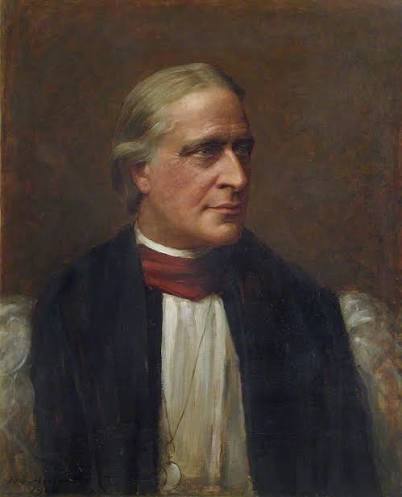 Edward White Benson (July 14, 1829 – October 11, 1896) was a prominent Victorian prelate who served as the Archbishop of Canterbury from 1883 until his death. Prior to
leading the Church of England, he was the founding Master (headmaster) of Wellington College (1859–1872) and the first Bishop of Truro.
Edward White Benson (July 14, 1829 – October 11, 1896) was a prominent Victorian prelate who served as the Archbishop of Canterbury from 1883 until his death. Prior to
leading the Church of England, he was the founding Master (headmaster) of Wellington College (1859–1872) and the first Bishop of Truro.
While publicly a pillar of high Victorian religious and institutional establishment, Benson’s life and family history are heavily studied by social and queer historians
today for their complex dynamics around sexuality, gender, and romantic attachment.
During the 19th century, British public schools (like Wellington, Rugby, and Eton) and Oxbridge colleges operated around intense male homosocial structures. Headmasters
and tutors often cultivated deep, emotionally charged relationships with select male students, blending spiritual mentorship, classical ideals of male friendship (often
patterned after ancient Greek traditions), and intense personal devotion.
As the founding headmaster of Wellington College, Benson formed close, protective, and emotionally intense bonds with favored pupils. Scholars like
Arthur Verrall (who later became a famous classical scholar at Trinity College, Cambridge) were central to Benson’s pedagogical
style.
Benson’s own youth reflected similar patterns. His sister later recorded his "almost romantic attachment" to his own headmaster,
James Prince Lee, the headmaster of King Edward's School, Birmingham. While at Cambridge, Benson privately confided in his
personal diaries a deep internal anguish and fear regarding his desires, writing that he feared he "might on some sudden occasion be led into a step I might all my life
repent."
Historians (notably Simon Goldhill in A Very Queer Family Indeed) often highlight the Benson household as one of the most remarkable studies in Victorian sexuality.
While Edward repressed his own romantic tendencies within rigid institutional duty, his wife and children navigated non-normative sexualities in distinct ways:
Edward proposed to Mary "Minnie" Sidgwick when she was just 12 years old (he was 23 and her second cousin). Their marriage
was fraught and emotionally distant for Minnie. After Edward’s death in 1896, Minnie lived openly in a committed lesbian relationship with
Lucy Tait (daughter of Archibald Campbell Tait, Edward’s predecessor as Archbishop of Canterbury). She also had romantic affairs with
other women, including composer Dame Ethel Smyth.
Edward and Minnie had six children. None of them ever married, and several became prominent literary figures whose works or private lives reflected queer themes:
E.F. Benson (Fred): Prolific novelist best known for the Mapp and Lucia series. He lived a discreetly homosexual life,
surrounding himself with gay artistic circles in London and Capri and writing works like David Blaize (1916), which depicted schoolboy romantic friendships.
A.C. Benson (Arthur): Master of Magdalene College, Cambridge, and author of the words to "Land of Hope and Glory". His
massive 4-million-word private diary documents intense homosocial attachments to younger men and deep psychological struggles.
Robert Hugh Benson: An Anglican priest who converted to Roman Catholicism and became a monsignor, writing popular
apocalyptic and devotional fiction.
Margaret Benson (Maggie) & Mary Eleanor "Nellie" Benson: Margaret was an
author and amateur Egyptologist. Nellie had a romantic relationship with composer Ethel Smyth before dying young.
A ghost story told by Benson to his friend, author Henry James, served as the founding idea for James's famous novella The Turn
of the Screw.
Edward White Benson and Minnie Benson produced a household where virtually every surviving adult member navigated homosexual or homosocial identity outside mainstream
Victorian norms.
References:
Other references:
- The Edward White Benson Diaries & Correspondence, Lambeth Palace Library (London)
- The A.C. Benson Diaries, Magdalene College, Cambridge
- Mary Sidgwick Benson Papers & Correspondence, Bodleian Library, Oxford
- Goldhill, Simon. A Very Queer Family Indeed: Sex, Religion, and the Bensons in Victorian Britain. University of Chicago Press, 2016
- Bolt, Rodney. As Good as God, as Clever as the Devil: The Impossible Life of Mary Benson. Atlantic Books, 2011
- Palmer, Geoffrey. The Benson Family: An Edwardian Chronicle. Intimate Books, 1988
- Vance, Norman. The Sinews of the Spirit: The Ideal of Christian Manliness in Victorian Literature and Religious Thought. Cambridge University Press, 1985
- Oxford Dictionary of National Biography (ODNB): "Benson, Edward White (1829–1896)" by Bernard Palmer; "Benson, Mary [Minnie] (1841–1918)" by Mark Pottle
- UK LGBT Archive: "Edward White Benson" / "The Benson Family"
Support this project
This website is a passion project researched, developed, and funded entirely by me. If you find the content valuable and would like to help support the ongoing research and hosting costs, any contribution is deeply appreciated.
Thank you for keeping this independent resource alive!
My books on Amazon: Elisa Rolle's books
BACK TO HOME PAGE